


The Churches of St. Anne and St. Bernardine (Church of St. Francis of Assisi) are clearly visible—albeit only their rear facades—from the beautiful Bernadine Park. Especially during the summer, it is highly recommended to take a scenic walk among the lush green trees beside the Vilnia River, a small tributary of the Neris, or even stop for a game of chess at the many stone tables positioned along the riverbank. Just outside the park, you can also climb a series of “scout-style” wooden stairs to reach the top of the Hill of Three Crosses, named for the Monument of the Three Crosses located there; it is easily spotted if you look up at the sky from the park entrance to your left. The view over the Old Town of Vilnius from the summit is spectacular.
But returning to our churches: St. Anne’s Church stands out among religious landmarks, particularly for its unique architecture. Built entirely from thirty-three different types of bricks in various shades of red, it boasts a Late Gothic style and showcases a “Flamboyant” Baltic variation that differs from traditional German Gothic. It was dedicated to Anna, the first wife of Grand Duke Vytautas and Grand Duchess of Lithuania, and was completed around the year 1500.
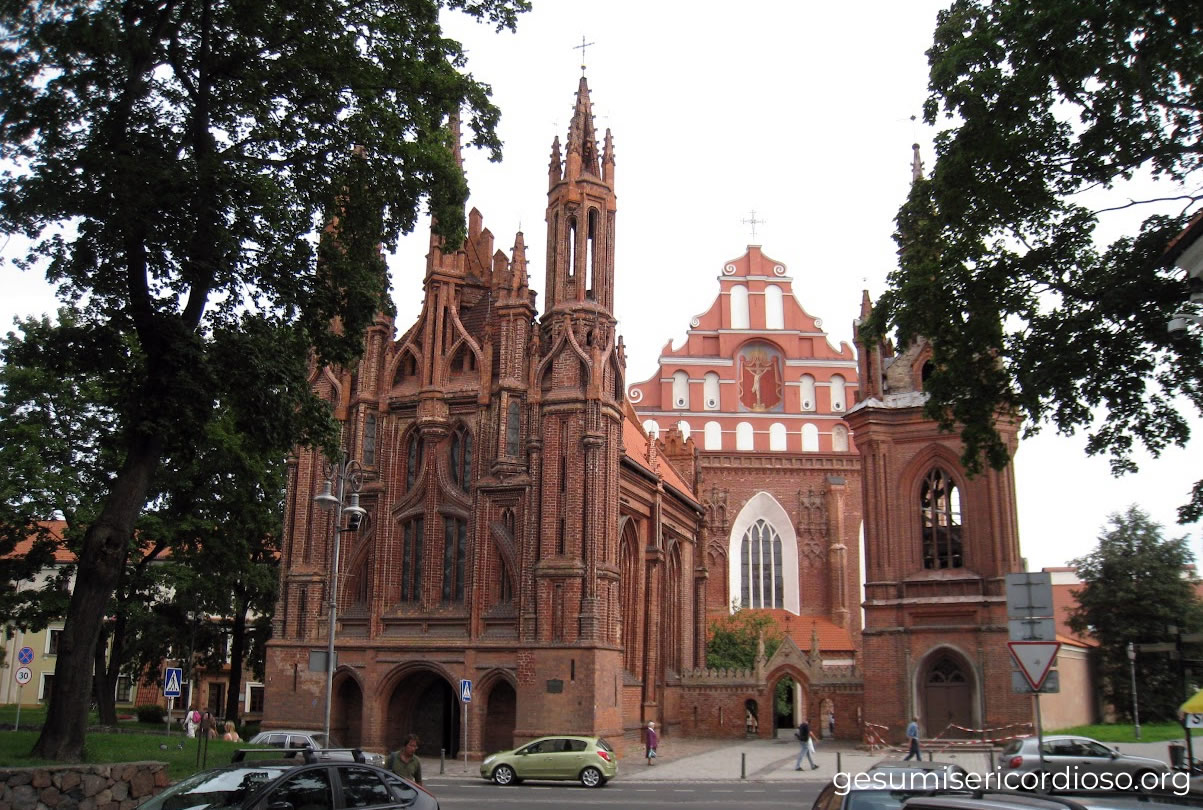
But returning to our Churches: St. Anne’s Church stands out among religious attractions especially regarding its style; entirely built from thirty-three types of bricks of various shades of red, it has a Late Gothic style and shows a typical Baltic Gothic variation compared to the German Gothic style. It is dedicated to the first wife of King Vytautas, Anna, Grand Duchess of Lithuania, and was built in 1500.
The very first construction of this Church however was not in 1500 but a full century earlier, presumably in the early 1400s, commissioned by the Grand Duchess herself. Built of wood, it was later destroyed and then rebuilt at the end of the 1400s by order of the King of Poland; obviously this reconstruction in brick is completely different from the wooden chapel that was previously there. Later, it was rebuilt and restored several times but the external facade remained almost entirely the original one. Initially intended for the use of German Catholics, it was also used by an important Protestant Lithuanian writer for his sermons, Abraomas Kulvietis, founder of the Vilnius college. Still today the church follows the Roman Catholic rite.
As a whole, inside, it proves to be a rather small church, with a wide external entrance typical of churches that contrasts with the two small internal wooden doors that lead us inside the church. Once inside, it appears in a welcoming, sweet and peaceful guise, and a rather modern or modernized style; composed of a single nave, with a soft light entering from the four stained glass windows located along the two sides of the structure. In front, as the only escape for our gaze, we can see the altar and a well-lit painting depicting the Blessed Virgin Mary with the Infant Jesus and Saint Anne. Let’s recall some notions from the Christian tradition: in the painting, three generations are represented since Saint Anne, according to tradition, was the mother of the Virgin Mary and therefore, the Infant Jesus, her grandson.
The Church, like the entire historic center in which it is immersed and from which it can easily be reached on foot, has been included since 1994 in the list of Unesco World Heritage sites and a legend says that Napoleon Bonaparte during his Russian campaign of 1812 was so fascinated by it that he expressed the desire to take the entire church with him “in the palm of his hand” to Paris. This will and devotion to the architectural beauty of the building however did not prevent his army from damaging its interior, and the church from being used first as a weapons depot and then as a prison for enemies.
The Bernardine Church (or of St. Francis of Assisi and St. Bernard) is a Roman Catholic church dedicated to Saints Francis of Assisi and Bernardine of Siena. Located just behind St. Anne’s church, stylistically similar but essentially different in shape and structure; we are still talking about a purely Gothic style but we can notice differences due to the Renaissance and Baroque influences that this church underwent during the 1500s and 1600s.
Consecrated in 1516, it too, like the church of St. Anne, was first built of wood in the 15th century and, later, in brick. In the same period the Bernardine Monastery was built right next to the Church.
The Bernardines arrived in Vilnius towards the middle of the 1400s under the Grand Duke of Lithuania and King of Poland, Casimir IV Jagiellon, as missionaries, and were entrusted with a plot of land near the banks of the Vilnia river. The construction of the church and monastery began in 1469, initially in wood, as mentioned, and following a fire in 1475 the reconstruction and subsequent restorations were carried out in brick. It is thought that starting as early as the 16th century (1500) the entire complex was part of the city’s defensive walls.
After the reconstruction of the 17th century (1600) the church took on typically Renaissance and Baroque traits, such as the Renaissance pediment and the pulpit. However, the presbytery remains typically Gothic, which is also the oldest part of the church, reaching us from 1500. Inside we also find the oldest sculpture of a crucifix in Lithuania, a crucifix dating back to the 1400s. Unlike St. Anne, the church has three naves and a rather high capacity: it is said in fact that the Bernardine monks tended to preach sermons that were very well attended by crowds and therefore a place large enough to accommodate them would have been needed. During the Soviet period it was closed and converted into a warehouse for a short period. Finally, it is good to remember that the monastery next door contains a rich library accumulated during the periods in which it served as a seminary and novitiate. Since 1919 the structure has been entrusted to the Vilnius Academy of Arts.
Article by Simone Serri