


At one time, the city of Vilnius was surrounded by defensive walls, as was typical for many other cities, and along these walls, there were nine gates providing access to the inhabited area, along with three towers. We are talking about a period between 1503 and 1522.
The Gate of Dawn is the only original gate remaining of the nine present around the old city in the 1500s; the other eight were destroyed following a tsarist decree towards the end of the 18th century. Often, religious chapels or sacred images could be found in these gates: in the Gate of Dawn (Aušros Vartai), presumably named so because it is located to the east where the sun rises, the painting of the Virgin Mary Mother of Mercy is still present today.

Aušros Vartai
Our Lady of the Gate of Dawn
Our Lady of the Gate of Dawn (or Our Lady of the Gate of Dawn) is an important painting because it belongs to the iconographic tradition of Black Madonnas and is an object of worship for both Catholics and Orthodox Christians; the artist is unknown, but it is dated to around the first half of the 17th century and is clearly of a Renaissance style; it depicts the Madonna without the Child, an interesting detail if we highlight it while talking about the painting of Merciful Jesus, which was once exhibited in this very chapel and is now located not far away in the Shrine of Divine Mercy.

View from the Gate of Dawn, Aušros Vartai
The day I visited the Gate of Dawn, I confess I had some difficulty finding the entrance to the chapel; while walking along the street called Aušros Vartų, you encounter various churches, first and foremost the Cathedral of Saint Casimir, patron of Lithuania and Poland, and further on, the Orthodox Church of the Holy Spirit and the Church of Saint Teresa; once close to our Gate, however, your gaze is captured solely by the small chapel glimpsed at the top of the Gate, and you continue walking until you pass under the arch. Too bad that beyond there is nothing, or at least nothing of what we are looking for. So, we turn back.
While turning back, I noticed a small group of people about to cross a small door located to the left of the street, facing the Gate of Dawn; I opened the door and immediately saw a crucifix in front of me: I understood I was in the right place. A curiosity, quite natural if you will, accompanies this singular entrance: initially, the only entrance to the chapel was inside the Carmelite monastery and women were not admitted; a gallery with an opening on the street side was then built.
A small flight of stairs to our right leads us toward the desired chapel; photos are not allowed, the place is sacred, and visitors and pilgrims are invited to pay their respects to the Madonna, or offer a prayer, in religious silence. The chapel is small in size; the painting of the Madonna is placed on a small altar to our left, exactly as we enter. Mass is still celebrated, and tourists are not allowed entry during the service: however, nothing stops us from taking part in the Eucharistic celebration if we wish.
The Painting of the Madonna of the Dawn
Speaking in more detail about the painting, it was initially placed in a small niche right above the gate, as per classic Catholic custom; after the Russo-Polish war of 1655, which also involved Vilnius being looted, the painting, as well as the defensive Gate, were handed over to the Discalced Carmelites. The Carmelites had arrived in Vilnius around the same period in the 17th century; they built the Church of Saint Teresa and their monastery right next to the Gate of Dawn.
It was a natural consequence to entrust them with the maintenance of the effigy and the construction of the first wooden chapel that housed the Madonna until 1715, the year it burned down and the painting was moved to the Church of Saint Teresa. From 1720, the current brick chapel was consecrated, and the effigy began to take on the appearance we see today: it was adorned with a metal casing typical of the Greek-Orthodox tradition; in fact, the “riza,” the metal sheet placed over paintings, is used by the Russian tradition to cover sacred images called icons, leaving the face and hands exposed.
The icon has been adorned with a crown since July 2, 1927, when the coronation ceremony took place and the painting received the title of Mother of Mercy, a special privilege granted by the Holy See for its particular veneration. In fact, the chapel is the recipient of numerous votive offerings made by many devotees, also due to the numerous stories of miracles attributed to the image.
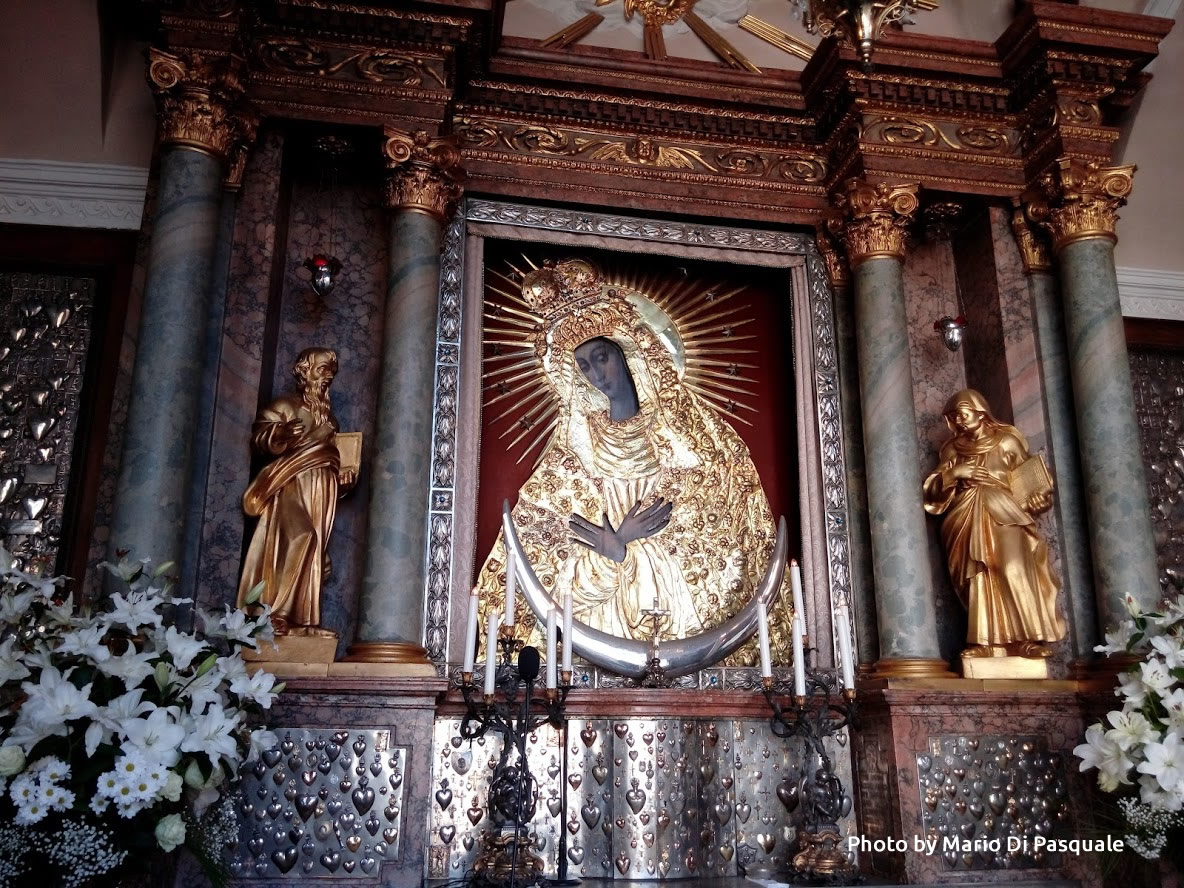
Madonna of the Dawn – Vilnius Lithuania
John Paul II, knowing the great devotion to Our Lady, during his visit to the Gate in 1993, wished to donate his white papal skullcap along with his purple cardinal’s zucchetto, as it had been impossible for him to donate it during his time as a cardinal due to the Soviet regime.
The cult of Our Lady of the Gate of Dawn developed alongside the desire and struggle for independence of the Lithuanian and Polish peoples, who at the end of the 1700s and throughout the 1800s were under Russian tsarist control. In fact, the Gate was a meeting place not only for prayer but also for political purposes. After the tsarist period, Lithuania and the area of Vilnius passed under Polish control first and then under Soviet control. Later, since 1990, independent Lithuania recognized the historical and religious importance of the effigy, and it remains a place of prayer and reflection today.
Article by Simone Serri