


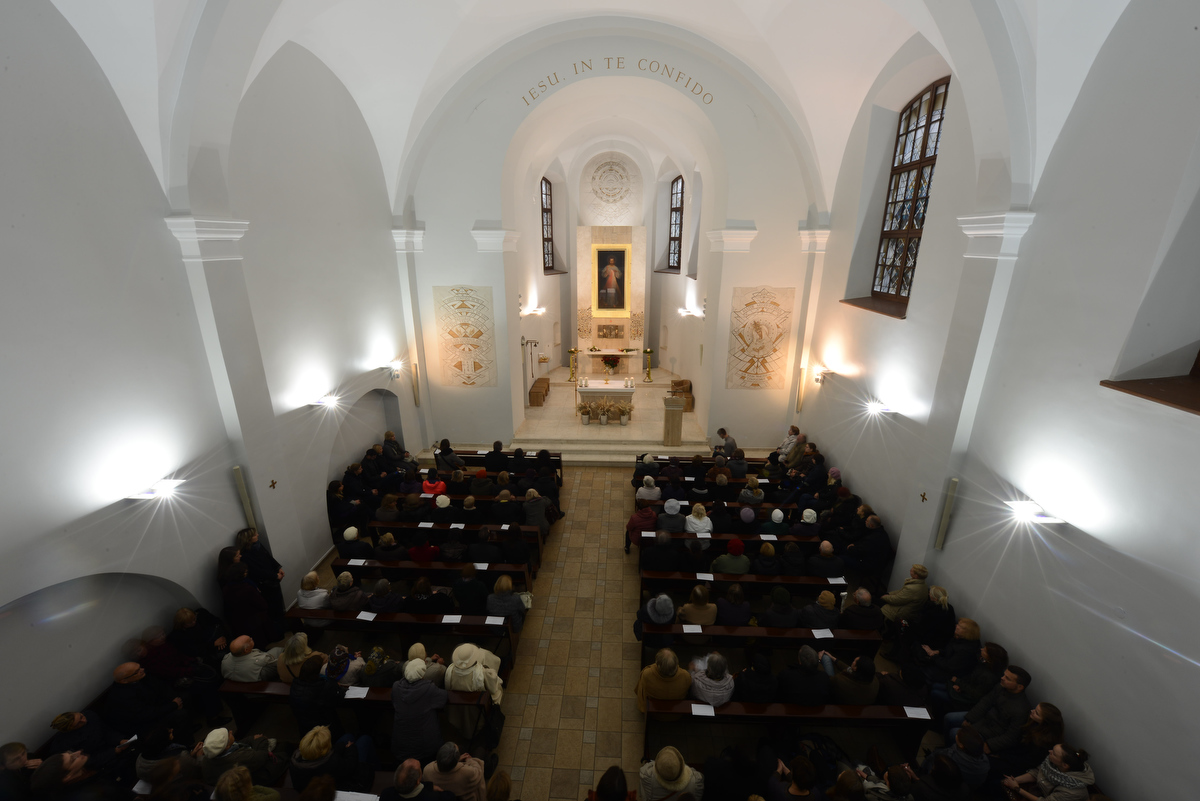
Walking along the main street, Dominikonų gatve, at a certain point on one side of the road, we find a small, hidden church. It is not just any church; we notice this by the fact that above the entrance is depicted the image of the Risen Christ, a reproduction of what we can see inside; in fact, inside this particular sanctuary lies the original painting of Merciful Jesus (or the Divine Mercy, or God’s Mercy, international name) commissioned to Eugeniusz Kazimirowski in 1934 in Vilnius by Saint Faustina Kowalska.
The history of the painting of Merciful Jesus
History tells us that the Saint had several visions of the Risen Jesus who urged her to give life to this painting; this happened to her in 1931, at only 26 years old, in the cell of the convent of the Congregation of the Sisters of Our Lady of Mercy in Płock, Poland. Later she moved to Vilnius, met Blessed Father Sopoćko, who became her important spiritual father, commissioned the painting and wrote a diary with her memories; she returned after a few years to Poland, by then ill with tuberculosis, and died in Krakow in 1938, at only 33 years old.
Let’s return to our painting. The Merciful Jesus was not always displayed in this sanctuary but underwent numerous vicissitudes. From 1934, the year it was first commissioned and then completed, the painting never stopped moving.
In 1935 it was exhibited near the chapel of the icon of the Mother of Mercy in the Gate of Dawn in Vilnius; later it was hung in 1937, after the authorization of the Archbishop of Vilnius, in the high altar of the Church of Saint Michael, where the Saint’s spiritual father, the now Blessed Father Sopoćko, was already parish priest: it remained there for 11 years until 1948. In that year, the Soviet regime closed the church of Saint Michael and the painting, like the entire building, was illegally purchased by a Lithuanian worker. From then on, the painting was no longer exhibited until 1956.
It was kept and hidden from the Soviet authorities by two devoted women, one Lithuanian and one Polish: initially in an attic and later in the Church of the Holy Spirit where, however, it was never exhibited.
It took the help of Father Józef Grasewicz, a former friend of Blessed Father Sopoćko, to allow the work to be shown to the public again: but this time in Poland, in Nowa Ruda (at the time Belarusian territory), where it remained exhibited for 30 years.
From 1956 to 1986 the canvas remained constantly in the Church of Nowa Ruda, despite the fact that in 1970 the church itself was closed and transformed into a warehouse by the Soviet regime.
The painting, therefore, remained there unguarded and was not stolen by the authorities for the simple reason that they did not have a ladder long enough to pull it down; once the most difficult period had passed, the painting was brought back to Vilnius in Lithuania, but not before having created a copy to keep in Nowa Ruda, so as not to arouse suspicion among the local authorities and the devoted faithful, who still went to pray in the decommissioned church. Back in Vilnius, the canvas was exhibited in the church of the Holy Spirit until 2005 and after numerous restorations it was repositioned in the adjacent small church of the Holy Trinity, reconsecrated precisely as the Shrine of Divine Mercy, where it is still present today.
What the painting of Merciful Jesus represents
The sacred image represents, indeed, Merciful Jesus intent on blessing pilgrims. Mention must be made, in this regard, of a second painting of Merciful Jesus, a copy of the Vilnius painting, namely the Krakow canvas; this second reproduction shows substantial differences due to the fact that the painting was created years later and only through the writings of the Mystic Saint and not directly from her instructions: in fact, the raised right hand, in the Krakow one, seems more to greet than to bless the pilgrim. The hand, intent on blessing and to bless, according to the liturgical dictates of the time, had to be exactly at that height.

The left hand, instead, shows the side pierced after death on the cross: the heart is not visible but from it rays emerge, one pale and one red, the water and the blood. The importance of the heart, veiled and not shown, reaffirms the difference between two different cults: what we go to venerate when we pray in front of the painting is not the Sacred Heart of Jesus, but the Divine Mercy; the object of the cult is, in fact, the rays.
What the blood and the water represent
A pale one (and not white!), which represents the water that comes out of the side after death on the cross, signifies purity and purification and recalls the water of baptism; it is the ray that “justifies souls” and also relates to the sacrament of reconciliation or confession.
The other, red, which represents the blood that flowed from the side, is instead defined as the “life of souls”, as reported directly from the diary of Saint Faustina, and relates to the other sacraments. The background of the painting, instead, is black: this “non” color symbolizes man’s sin; it is the image of the Risen Christ who presents himself to the apostles in the upper room after death, with his feet intent on walking in sin, which represents the will to get his hands dirty and meet man in difficulty; baptizo in Greek means exactly “immersion”. Jesus with his baptism accepts, in everything, the mission entrusted by the Father, to redeem and forgive all humanity of its sins.
An interesting curiosity: the face in the painting was compared with the face depicted in the Holy Shroud, and, after careful analysis, they were found to match. As well as with the face depicted in the Sudarium. Very probably we are facing the true face of Christ.
Article by Simone Serri