


Even today, I like to think that upon entering the Church of Saint Casimir, one can still hear the sweet choral religious singing that I heard the first time I walked through those doors. I didn’t immediately realize where those voices were coming from, so much so that I thought they were recordings because they were so perfect; however, walking inside the church, I noticed two women who were not simply intent on praying, but were carefully and precisely giving life to a musical movement: they were the choristers.
Popular tradition passes down a singular concept, often erroneously attributed to Saint Augustine, which says: to sing well is to pray twice, and I am convinced that those two unknown women did God’s grace with their beautiful singing.

Church of Saint Casimir, Vilnius
History of the Church of Saint Casimir
The church was founded by the Fathers of the Jesuit Order starting in 1604, the year construction began, until 1635, the year it was consecrated. It underwent several reconstructions: the first, but not the only one, following a fire in 1655 caused by the arrival of the Russian army in Vilnius.
The original building and subsequent reconstructions remained faithful to the Baroque model of the Church of the Gesù in Rome (Il Gesù), the Mother Church of the Jesuit Fathers, although there are two small turrets on the sides of the front facade not present in the Roman church: it is the first and oldest Lithuanian Baroque church.
From 1751 to 1753, significant work was carried out inside the Church, including the fresco on the life of Saint Casimir, painted by the Czech artist Joseph Obst; while the interiors were decorated by the Prussian sculptor Hans Kierner. From 1773, the church passed into the hands of the Augustinians due to the suppression of the Jesuit order.
In 1813, the Church was converted into a granary by the French army and in 1839 reconverted into an Orthodox Church by the Russian army. In 1915, the German army transformed it into a Lutheran house of worship for its own military.
In 1919, the church returned to the hands of the Jesuits.
The Style of the Church
Stylistically, as mentioned, it is a typically Baroque Church; we notice this from the intention to wonder with splendor and monumental architecture, and the reference, obviously, to Classicism: the only true point of reference for the history of art and architecture of this period.
The interior of our Church is laid out in a Latin cross with three naves, with the central nave much wider than the side ones: the three naves meet under an enormous dome where the altar is located.
The majesty of the presbytery and the apse, with paintings of the Risen Christ and the Patron Saint, leaves no words for description. In more recent times, in 1991, a crypt dating back to the 1600s was discovered under the main altar.
Where the Church of Saint Casimir is Located
It is located on Didžioji gatvė, in the UNESCO World Heritage Old Town, in front of Vilniaus Rotušės aikštė (Town Hall Square), where the old historic town hall dating back to the 1400s stands with a 19th-century Neoclassical reconstruction—the main center for cultural gatherings, events, and congresses in the city. It precedes and introduces the now well-known Aušros Vartų, the street that leads us to the Gate of Dawn.
Saint Casimir, the Patron Saint of Lithuania
Saint Casimir is the patron saint of Lithuania and one of the most important Polish saints, as well as a patron saint of Poland itself; although Lithuania had been Catholic for more than a hundred years, by 1500 it did not have a saint of Lithuanian origin. Casimir was born in Krakow but was part of the Lithuanian Jagiellonian dynasty, which had ruled Lithuania and Poland until approximately 1500.
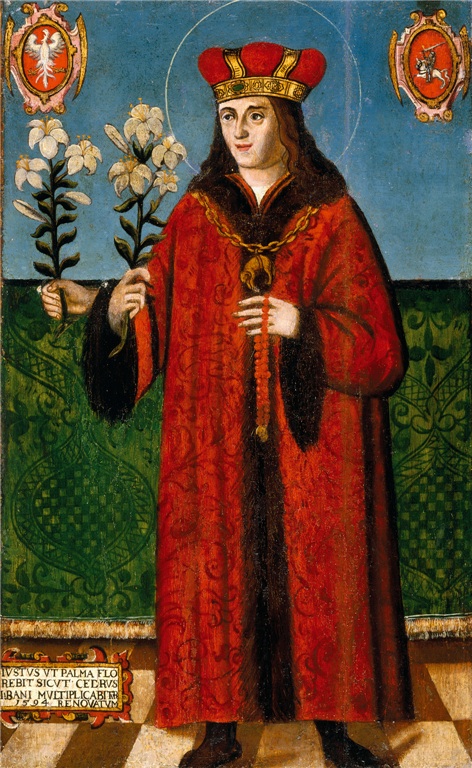
One of the oldest images of St. Casimir. It is believed to have been created in the 16th century AD.
A promising young man and a fervent religious figure, the third son of Casimir IV, King of Poland, he died at only 25 years old, unmarried, because he refused to enter the marriage arranged for him by his father. He died in Lithuania after a journey to reach his father who was governing the territory. He passed away from tuberculosis, which struck him due to a physical state weakened likely by the continuous fasting he undertook for his religious faith.
He was beatified and then canonized by Pope Leo X, although there are no reliable sources regarding this; it is rather thought there was a need in the Lithuanian land to provide a figure as a model for the people and especially for the youth. In fact, it was only in 1602 that the cult of the saint was officially recognized by the Church of Rome, and on that occasion, the tomb of the young Grand Duke, located in the ancient and first cathedral of Vilnius, was opened and his holiness sanctioned. He became the patron of Lithuania about thirty years later, following the construction of the church that bears his name, and in 1948, also the patron of Lithuanian youth. Even today, the relics of the Patron Saint can be found in the small chapel dedicated to him inside the Vilnius Cathedral.
Article by Simone Serri