


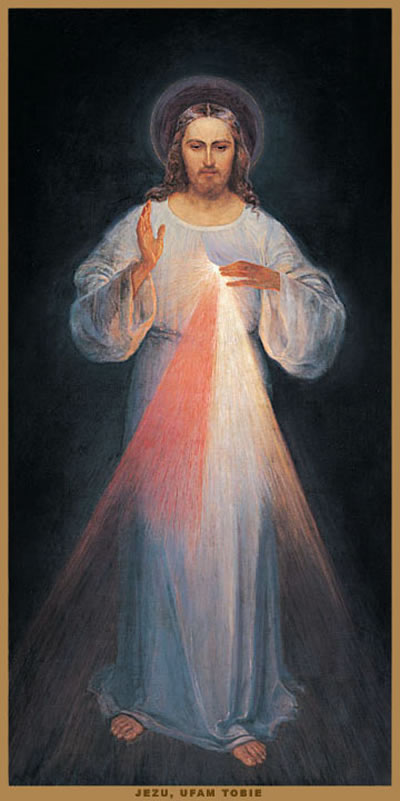
The Image of Merciful Jesus is not just a work of art, but a vessel through which, as promised by Jesus to Saint Faustina, souls can draw graces from the fount of Mercy.
The History: From the Diary to the Canvas
The Creation of the Work in Vilnius
The painting process lasted about six months. Faustina visited the painter’s studio once or twice a week to give precise instructions on every detail: the position of the hands, the direction of the gaze, and the shading of the rays. However, as the work took shape, the Saint fell into a state of deep sadness. She felt that colors and brushes could not in the least render the divine beauty she had contemplated in her visions.
In her Diary, Faustina recounts bursting into bitter tears, complaining to the Lord: “Who will paint You as beautiful as You are?”. Jesus answered her gently, explaining that the value of the image does not reside in the beauty of the art or the color, but in His grace acting through it.
Corrections and Details
The work was meticulous. Father Sopoćko himself posed wearing an alb to help Kazimirowski correctly reproduce the folds of the garment and the movement of the arm. There were constant corrections, especially regarding the face and the gaze. Jesus had asked that the gaze be “the same as My gaze from the cross”—that is, looking downward, with an expression of infinite mercy rather than judgment.
The Final Result
Although Faustina was not fully satisfied with the aesthetic result, she obeyed the divine will. The painting was finished in June 1934 and initially remained in the corridor of the convent of the Bernardine Sisters, before being exhibited for the first time at the Gate of Dawn in 1935. It is precisely this human “imperfection,” compared with the celestial vision, that makes the Vilnius image a unique spiritual relic: the closest possible attempt, however limited, to capture the essence of Divine Love.
“By means of this Image I shall be granting many graces to souls; it is to be a reminder of the demands of My mercy, because even the strongest faith is of no avail without works.” (Diary, 742)
Jesus’ Requests and the Promises for those who venerate the Image
Jesus’ request to paint this image did not have a purely artistic purpose, but represented the divine will to offer humanity a concrete channel of grace. In her Diary, Saint Faustina records the exact words of the Savior: “Paint an image according to the pattern you see, with the signature: Jesus, I trust in You”. This inscription is not an optional element, but constitutes the foundation of the devotion, as trust is the necessary “vessel” to draw from His infinite Mercy. Jesus explicitly asked that the image be venerated throughout the world, starting from her own chapel to every corner of the earth, promising that the soul that will venerate this image will not perish.
The promises linked to this devotion are immense and touch upon the most critical moments of human existence. Jesus assured victory over enemies already here on earth, but above all, a special protection at the hour of death: “I Myself shall defend it as My own glory” (Diary, 48). Furthermore, the image serves as a constant reminder to act with mercy toward one’s neighbor, as Jesus emphasized that even the strongest faith is in vain without works. The veneration of the image is therefore an act of total entrustment that guarantees peace in families and divine protection in adversities. As explained by experts of the devotion such as Father Mariusz Marszałek, the original Vilnius image, created under the Saint’s guidance, preserves precise theological details — such as the dark background from which the light of Christ emerges — that serve to focus the soul on the hope of the Resurrection and the forgiveness of sins. To venerate this image means, ultimately, to accept Jesus’ invitation to take refuge in His pierced Heart, the inexhaustible source of life and holiness.
The Spiritual Meaning: Symbols of Grace
Every detail of the image was dictated by Jesus Himself and possesses a precise theological meaning:
The Two Rays
The rays emanating from the pierced heart—which is not visible but is the source of the light—represent the Sacraments:
- Red Ray: Symbolizes the Blood, which is the life of souls. It refers to the Eucharist.
- Pale Ray: Symbolizes the Water, which justifies souls. It refers to Baptism and Confession.
The Hand and the Step
- The Right Hand: Is raised in a gesture of blessing, as in the apparition in the Upper Room after the Resurrection.
- The Movement: Jesus is not static; He appears to be walking toward the observer. It is God seeking out man.
The Gaze and the Face
The Expression: It is gentle and merciful. Jesus told Faustina: “My gaze from this image is like My gaze from the cross” (Diary, 326). It is a gaze of forgiveness, not of judgment.
The Inscription: “Jesus, I trust in You”
Jesus explicitly asked that these words be clearly written. They represent the fundamental attitude of the Christian: total surrender to the will of God.
Curiosity: The Face and the Shroud
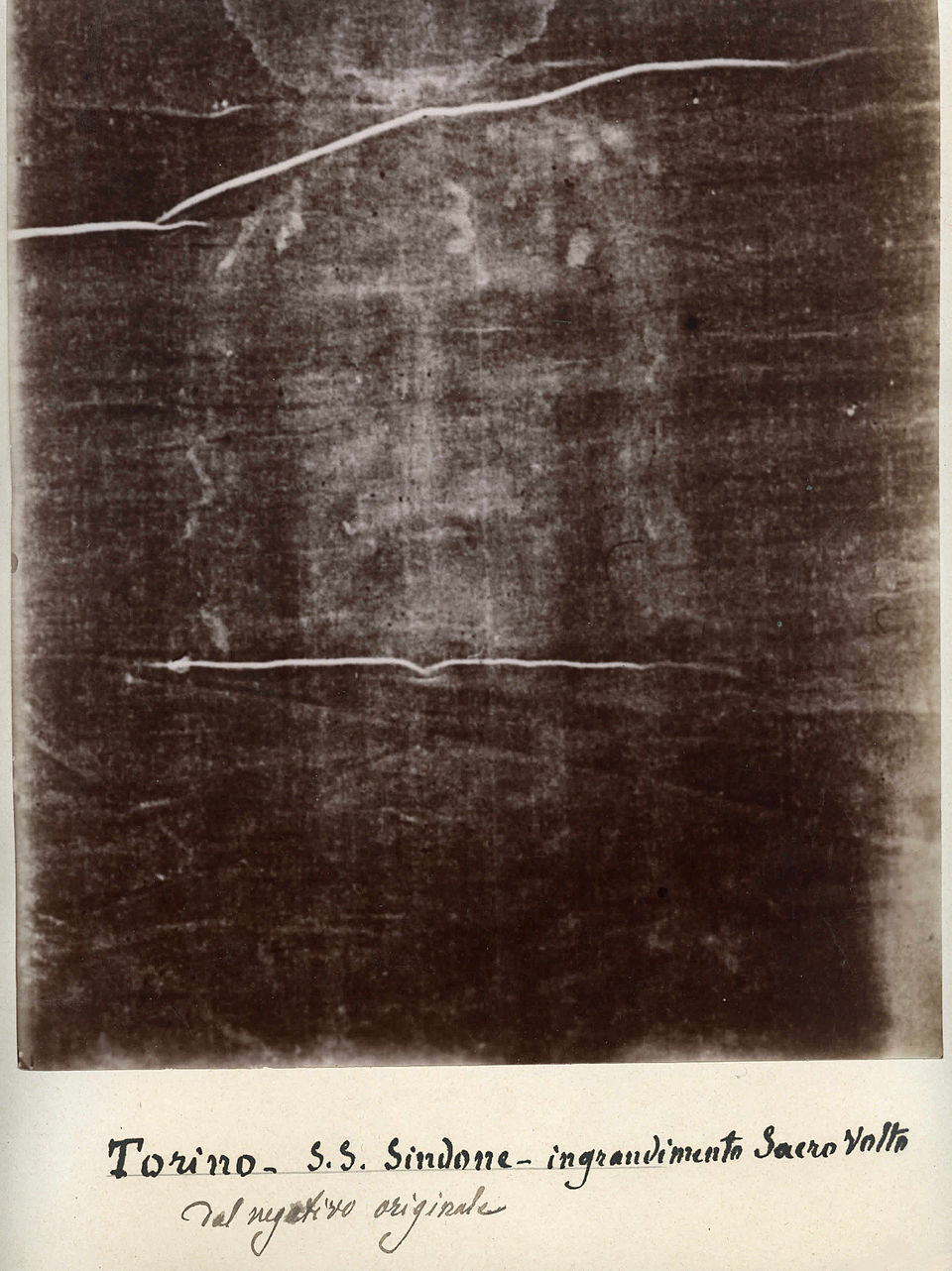
Scientific studies have shown that the face of Jesus in Kazimirowski’s painting perfectly coincides with the proportions of the face on the Holy Shroud of Turin, confirming the accuracy of Saint Faustina’s vision.
The “Polish Version”: The Image of Merciful Jesus by Adolf Hyła
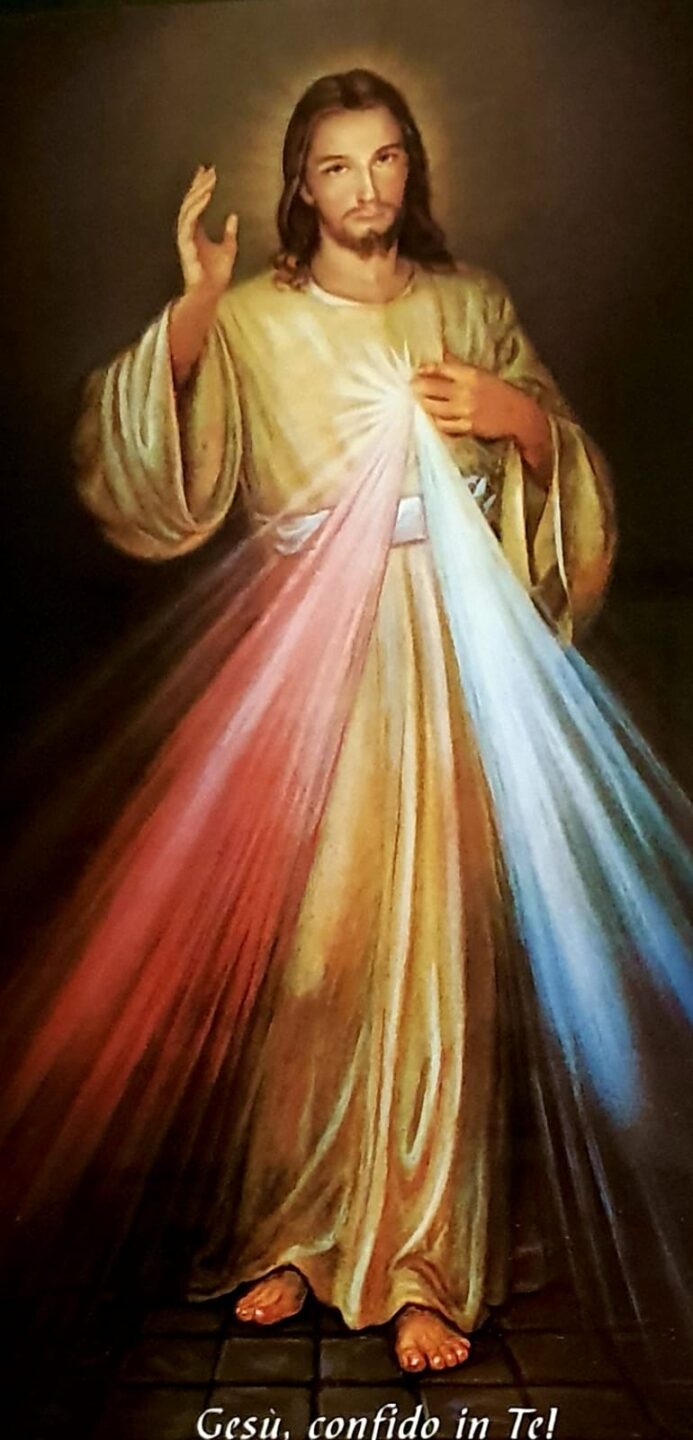
Although the Vilnius image is the only one created under the supervision of Saint Faustina, the most well-known and widespread image in the world is the one painted by Adolf Hyła in 1944, preserved in the Sanctuary of Divine Mercy in Kraków-Łagiewniki.
Why is it the most famous?
- Votive offering for the war: Hyła painted the image as a thanksgiving for having survived the Second World War. Its massive spread occurred precisely during and after the conflict, becoming a symbol of hope for war-torn Poland.
- Closure of the border: For decades, Vilnius (where the original was located) remained behind the “Iron Curtain” of the Soviet Union, making the original painting almost inaccessible. Kraków, instead, became the global center of the devotion, thanks also to the impulse of Saint John Paul II.
Differences from the original
- The background: Often (in the early versions) it featured a landscape or flowers, which were later removed by order of the ecclesiastical authorities to make the background dark, as requested by Jesus.
- The gaze: While in the original the gaze is directed downward (as from the Cross), in the Polish version, Jesus’ eyes are often turned directly toward the viewer.
- The artistic impact: Hyła used a more devotional and modern style that facilitated reproduction on prayer cards and prints all over the world.
Note of faith: Although it is not the “historical” original, the Church recognizes the Kraków image as a legitimate channel of grace, since what matters is the invocation “Jesus, I trust in You” and the attitude of the heart.
Official Holy See Document: “To fully understand the universal scope of this message, we invite you to read the Homily for the Canonization of Saint Faustina, delivered by Saint John Paul II in St. Peter’s Square on April 30, 2000.”