


The Vilnius Cathedral, also known as the Basilica of St. Stanislaus and St. Ladislaus, is a Roman Catholic structure from the late 18th century. It is one of the most significant Catholic places of worship in Lithuania, where numerous kings were crowned and prominent nobles and clergy were buried. Built in 1783 by order of the Bishop of Vilnius following the destruction of the previous cathedral, it represents the Baptism of Lithuania and features a pre-Neoclassical style. Neoclassicism was a cultural trend that developed in Europe in the early 1800s, with Neoclassical architecture being one of its most representative examples. The defining characteristic of this style is the desire to return to ancient Greco-Roman splendor and the highly acclaimed classical art—imitating the classics without direct copying, but rather reflecting their attitude and predisposition: hence the name Neoclassicism.
Our cathedral, if observed closely, possesses all the power of the classical style, interpreted through Baltic sensibility. Let us not forget that this basilica is the reconstruction of an ancient cathedral dating back to 1251, commissioned by King Mindaugas following his personal conversion to Christianity, although after his death the building became a pagan site. Later, after the official conversion of Lithuania to Christianity in 1387, a second cathedral was built, followed by a third around 1400 on the remains of the second; some walls and pillars of this third cathedral have survived to this day. In the 16th century, the cathedral was restored and almost completely rebuilt, taking on typical Renaissance features, and the bell tower was constructed. A unique detail is the distance of the bell tower from the main building, a feature uncommon for churches outside of Italy. It is thought to have been part of an ancient medieval wall; in fact, the base dates back to that period. Over the following two centuries, cycles of destruction and reconstruction followed until 1779, when the final reconstruction was commissioned to the architect Laurynas Gucevičius in the Neoclassical style we see today.
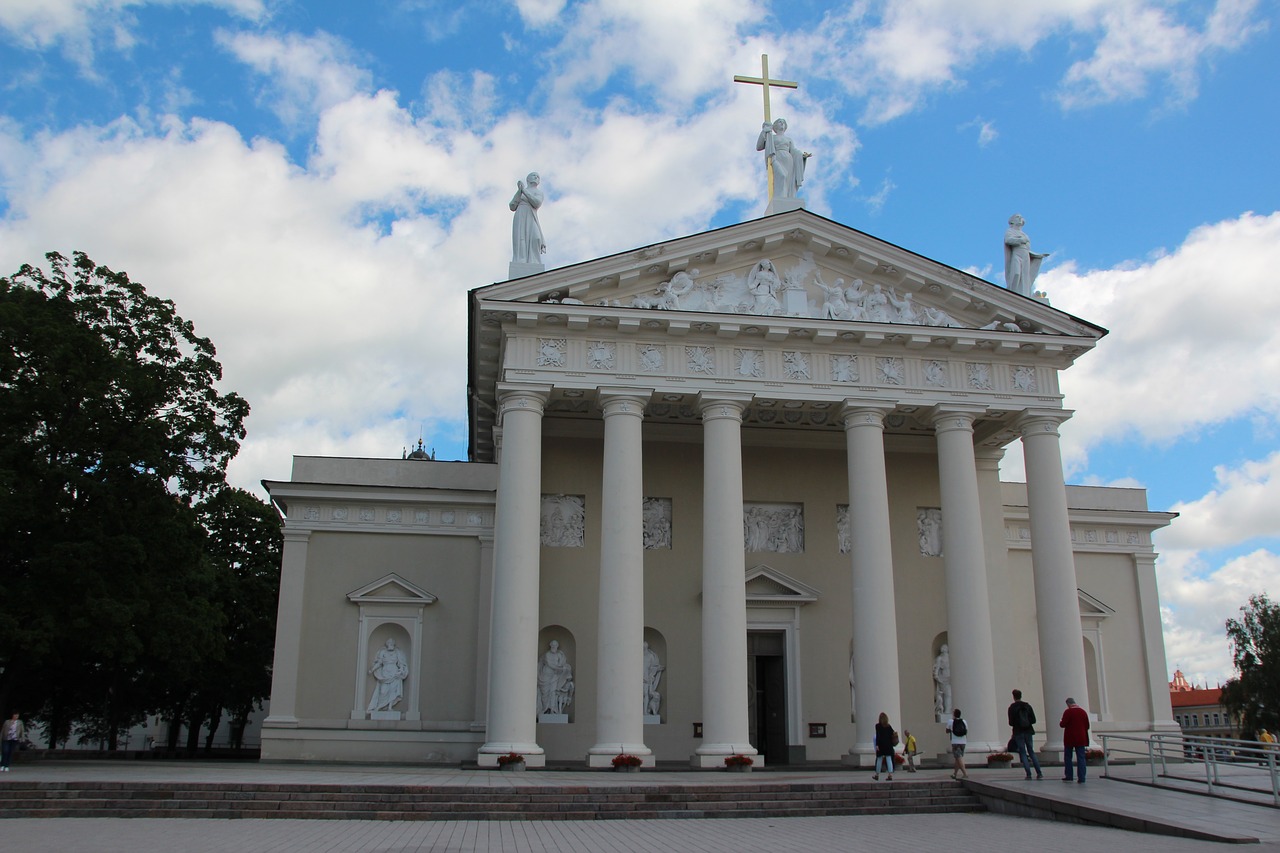
The Exterior of the Vilnius Cathedral
The exterior is presented precisely in a Neoclassical style, with influences stemming from various reconstructions; overall, we see a classical portico with six columns, modeled after a Greek temple, and a triangular pediment typical of Neoclassicism.
On the central facade, we find important sculptures by Tommaso Righi, a famous Italian sculptor also known for his collaboration on the Palazzo Chigi in Rome during the late 18th century. The most significant is undoubtedly the sculpture of Saint Helena holding the Cross, but we also find representations of the four Evangelists. The side facades, meanwhile, feature two Doric porticos. On the roof, above the central pediment, stand three statues from the late 18th century representing Saint Casimir, symbolizing Lithuania; Saint Helena with the golden cross; and Saint Stanislaus, symbolizing Poland.
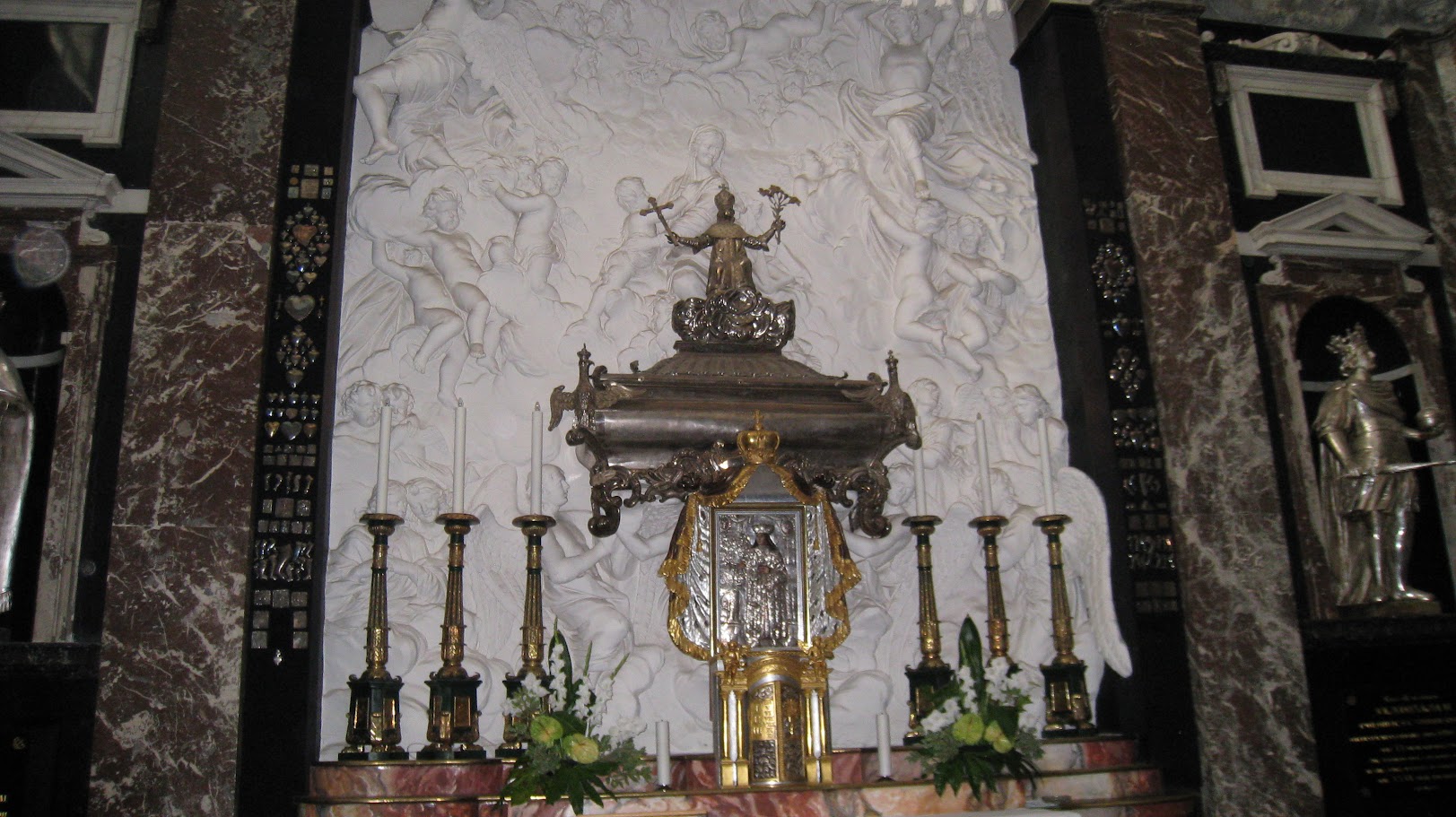
The Interior of the Cathedral
The interior of the Basilica is designed in the style of a hall church with three naves, meaning the central nave is at the exact same height as the side aisles—a feature not found in most classical basilicas, where side aisles are typically lower. To divide the three naves, there are two rows of pillars, and on each pillar sits a 19th-century painting representing each of the Apostles. A distinctive characteristic is the absence of an apse (the semicircular structure at the end of a Christian building that usually encloses the presbytery); this absence makes the presbytery the final element of the Church, serving as the location for the altar and the space reserved for the clergy’s celebration.
I mentioned earlier that the walls of the third cathedral built around the 14th century can still be seen; obviously, the external walls do not belong to that period, but inside the church, we find crypts where the original walls are preserved, along with Lithuania’s oldest fresco of the Crucifixion of Christ, dating back to the 14th century.
The interior also houses a beautiful Baroque-style chapel dedicated to Saint Casimir, which holds the relics of the Patron Saint of Lithuania. Inside, there is a high-relief depicting the Glory of the Virgin and a Byzantine image of Saint Casimir himself.
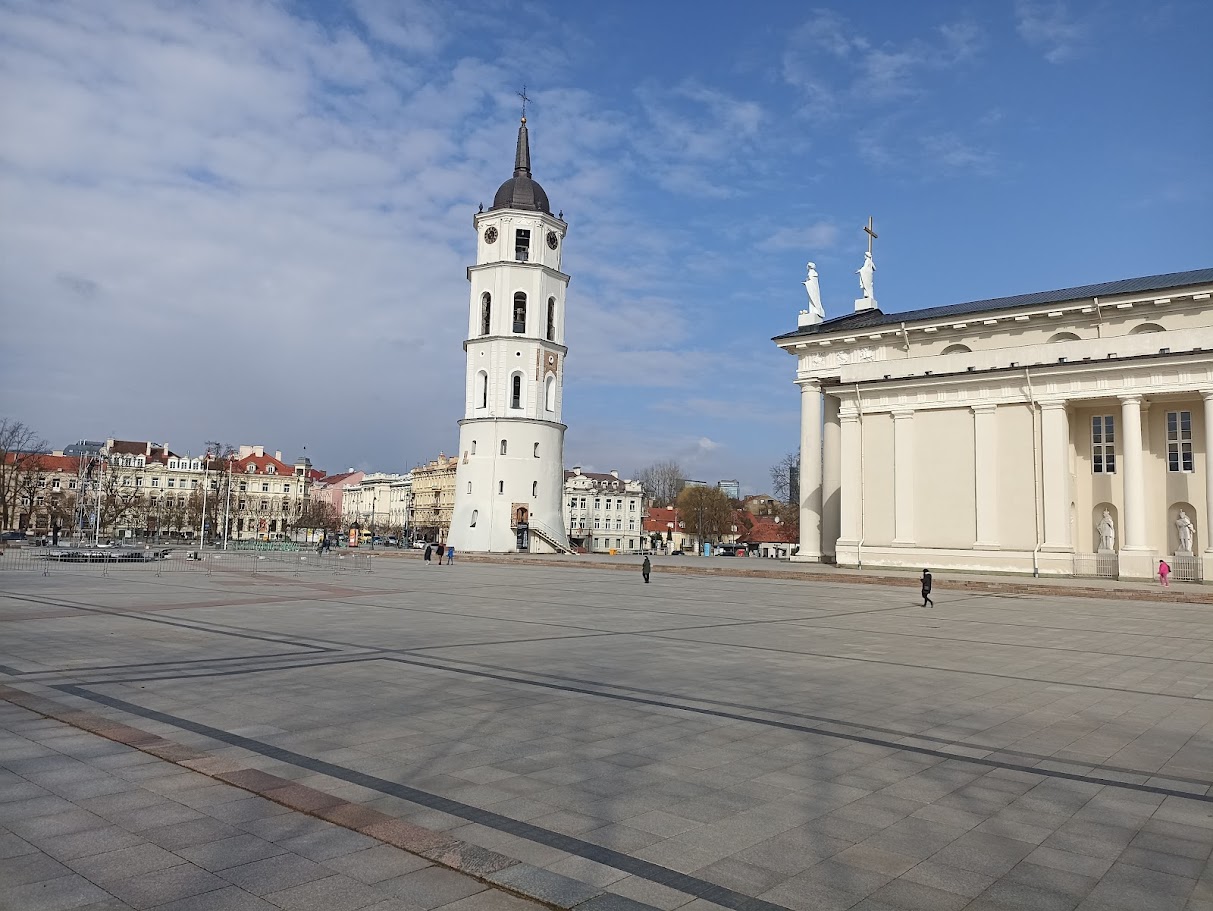
Cathedral Square
The cathedral stands in the heart of the city’s historic center in a massive Square, constructed later around the Basilica; it is the most important meeting place in the entire city, where markets, festivals, and celebrations are still held today. During Christmas, a huge tree is displayed in the center of the square with a large Nativity scene. In previous years, the square was used for Russian military parades and the annual Saint Casimir’s fair. Located near the hill where the Gediminas Tower (a must-visit site) rises, the play of colors created at sunset is stunning: in whichever direction you look, the view stretches across the vast square illuminated by the soft light of the setting sun, followed by the first artificial lights that gradually expand and replace the colors of the sky, creating a sense of pleasure in body and mind. Beside the Basilica, a monument to Gediminas, the first Grand Duke of Lithuania, was erected in 1996. Indeed, this proliferation of statues and bronzes over recent decades is a characteristic of the city of Vilnius.
To conclude, a curiosity: a popular belief leads tourists to search this square for a special tile that can grant wishes. Legend has it that from that exact spot, the revolution began that united Vilnius, Riga, and Tallinn toward the independence of the Baltic States from Soviet rule; in fact, the Magic Stone is engraved with letters forming the word stebuklas, which in Lithuanian means Miracle.
Article by Simone Serri